Edward Boatman • May 27th
When Katie Burrell talks about the pace of the New Jersey cannabis market, she isn't just talking about growth. She is talking about a 50-SKU sprint. In January 2026 alone, Glass Meadows launched roughly fifty individual products. Managing that volume would be a feat for a seasoned consumer packaged goods veteran, but doing it in an industry where retailers often rename your products on a whim requires a specific kind of operational grit.
"I’ve been in the industry for almost 10 years now," says Burrell, who currently serves as the Marketing Manager for Glass Meadows. "I have my own history with the plant and using it for self-medicating my own ADHD. I started my career in New York doing digital PR and I just couldn't do it anymore. I needed to do something I actually cared about. And I loved cannabis, so I figured cannabis marketing made sense."
That passion is now directed at promoting brands and products Burrell is passionate about, while making it easy for retailers and wholesalers to market the Glass Meadows products. As many cannabis brand marketers can relate to, getting your products into the market is one thing, but getting all of the messaging consistent is a whole separate beast.
As Glass Meadows continued to add SKU’s to the market, it was important to focus on operational efficiencies, too. This is where Chris Moore, the Head of Marketing at Glass Meadows, led the vision in how Glass Meadows operated internally and showed up externally. In order for Burrell to focus on keeping brand assets, product information, menu materials, and retailer-facing resources consistent, she needed to have the right tool set. This is when they collectively realized their Google Drive document was no longer going to meet their needs.
A snapshot of the Glass Meadows Google Drive document. Items have been crossed out to communicate this is no longer a valid document.
Before Lingo, Glass Meadows relied on their Google Drive document to communicate their retailer-facing resources. It was an excellent starting point and allowed them to seamlessly communicate product information and assets with retailers, that is, until the SKU count started to grow. Over time, Glass Meadows ramped up to six different brands, and collectively, SKU’s into the hundreds. What worked well before was quickly becoming cumbersome and a bottleneck.
Having been familiar with Lingo from other cannabis companies, Moore introduced Lingo to Burrell and pushed for Glass Meadows to implement a true DAM for cannabis system. The change positioned Glass Meadows to focus more on presentation and scalability, helping the team to centralize assets and organize product information in a way that was more friendly to retailers. In turn, the Glass Meadows marketing team could better manage menu consistency and was able to better support retailers with training materials.
“I feel like this is one of the reasons Lingo has become so successful among cannabis companies—they make it really easy to display and distribute our brand assets and product information together. Menu consistency has become a real problem in the cannabis space, and it feels like Lingo hears us and is consistently improving the product. It's so much easier for teams like mine to communicate with retailers and wholesalers with Lingo” says Moore.
By transitioning from a Google Drive doc to Lingo, Moore, Burrell, and the Glass Meadows team made a small but important step in scaling the business: a firm foundation where the product could scale without abstract limitations set by a tool. Retailer portals like this one help the Glass Meadows team to communicate brand kits containing product descriptions and downloadable assets, alongside training materials to help the budtenders to better sell the brand.
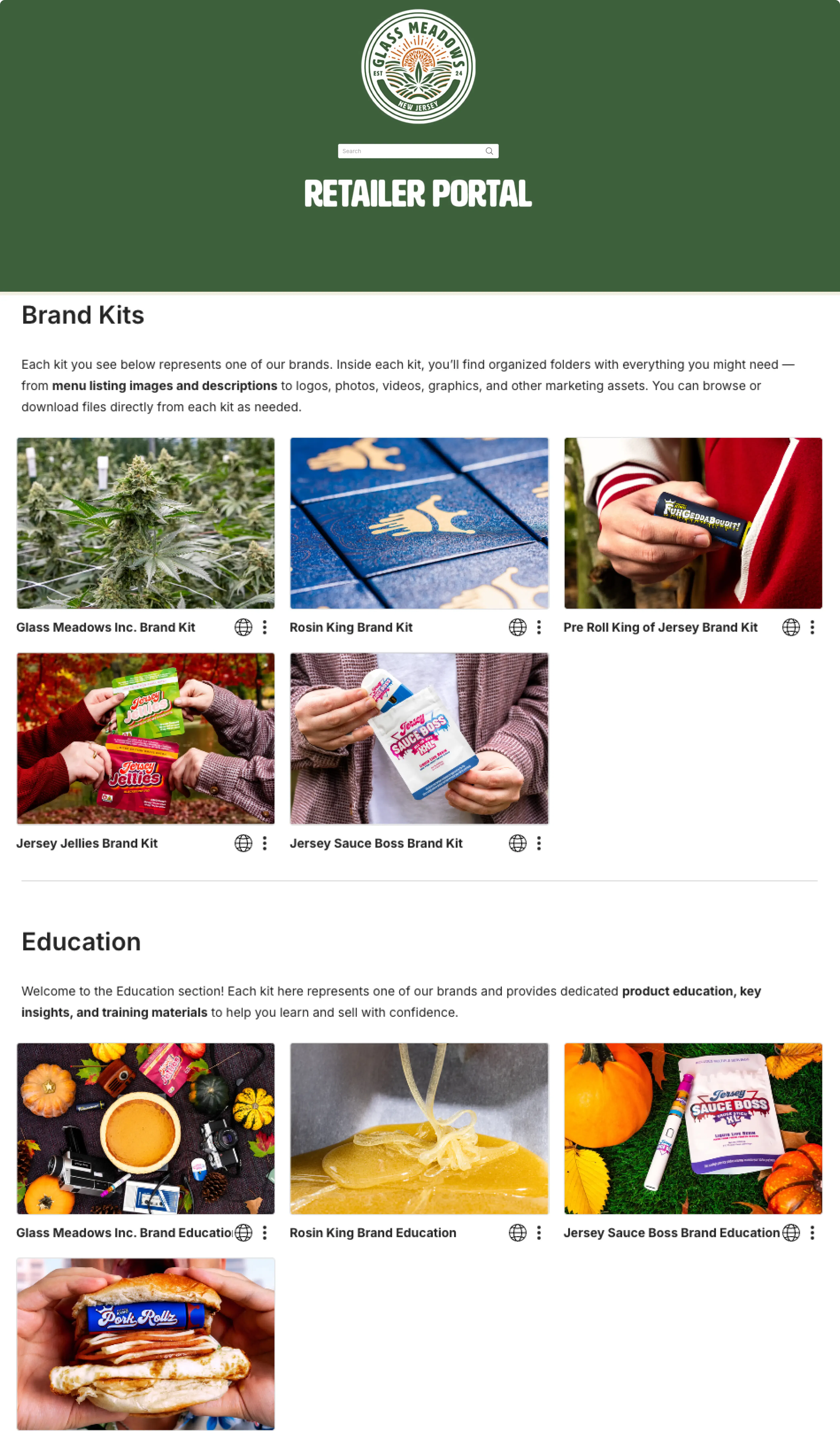
View the Glass Meadows Retailer Portal to see how they structure their Kits.
Scaling a house of brands means moving away from the "one size fits all" marketing of the early legalization days, and that first comes with a clear brand shift. To reflect who they are today, Burrell has segmented the internal brand architecture to speak to each brand separately and she does that with a portal and kit structure.
For context, think of a Kit like a folder. You put items into different folders based on what you want to convey. So, for example, Glass Meadows creates a Kit for each brand, complete with their product information. When a Kit like this is shared with a retailer, it makes it easier for retailers to locate the correct digital assets and supports more consistent menu accuracy.
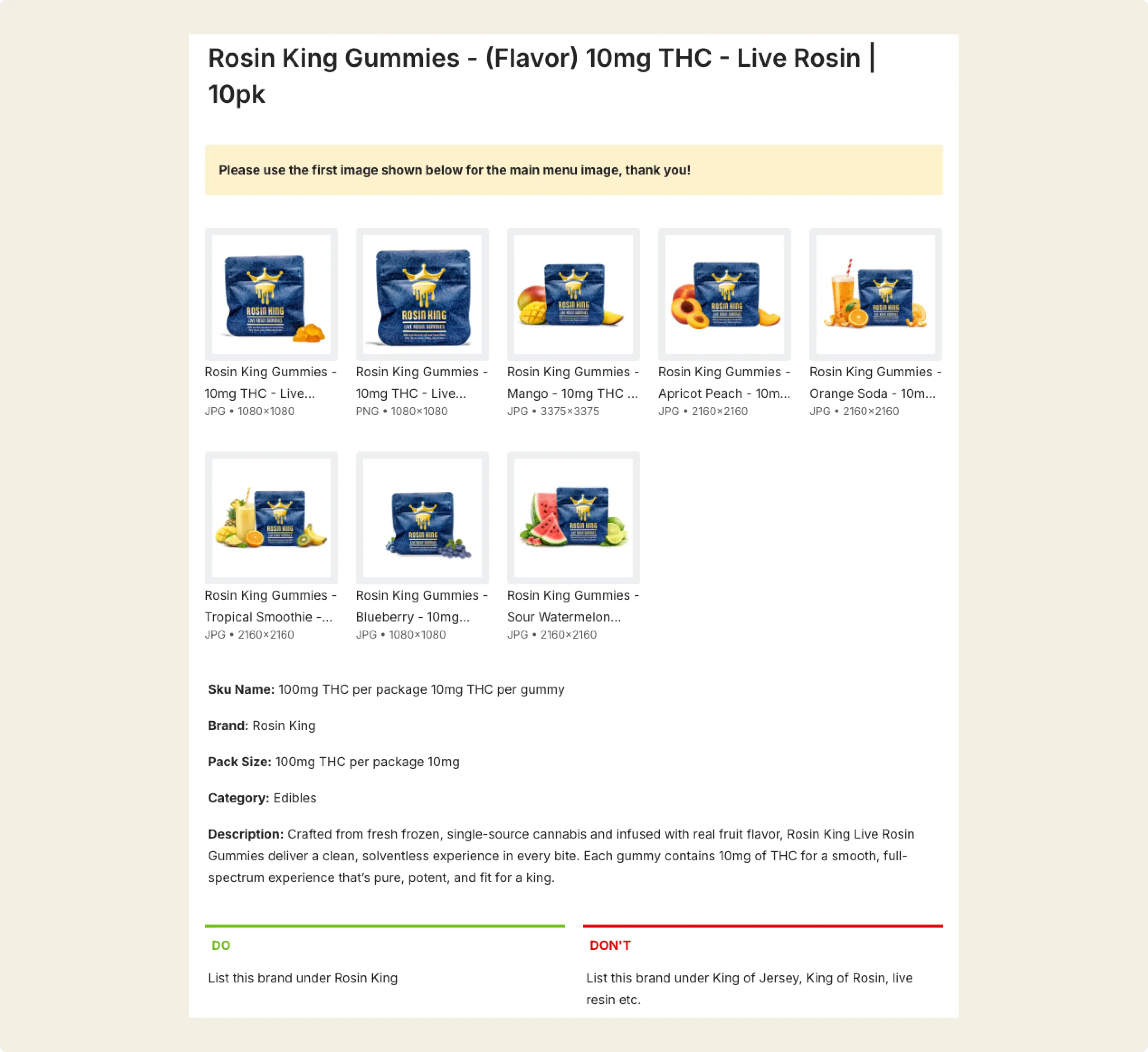
View this product description in the Glass Meadows Rosin King Brand Kit.
Glass Meadows separates their training materials so that retailers know how to best sell the product. These are two different end-points that are of equal importance to Glass Meadows: the brand kits establish the source of truth in how to list their product in point-of-sale systems, and the training materials educate budtenders on how to sell their product.
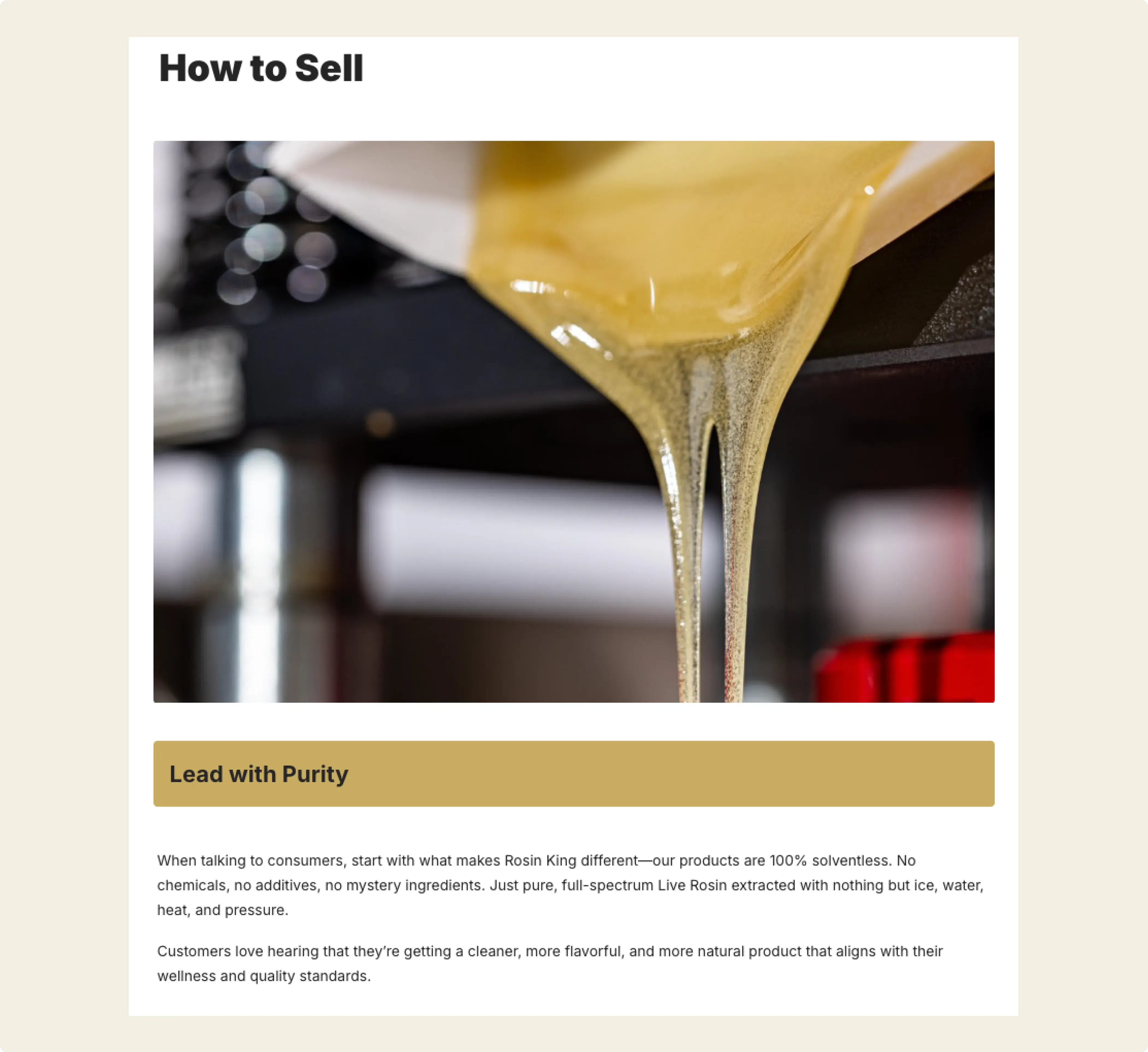
Visit the Rosin King Brand Education Kit to see how they use Lingo for budtender education.
With Kits created, Glass Meadows places them into different portals to share to just retailers, only internally, or even just Kits associated with a specific brand. This gives access to different audiences but keeps their product information available alongside downloadable assets, making it easier to share a single link for anyone to access their product.
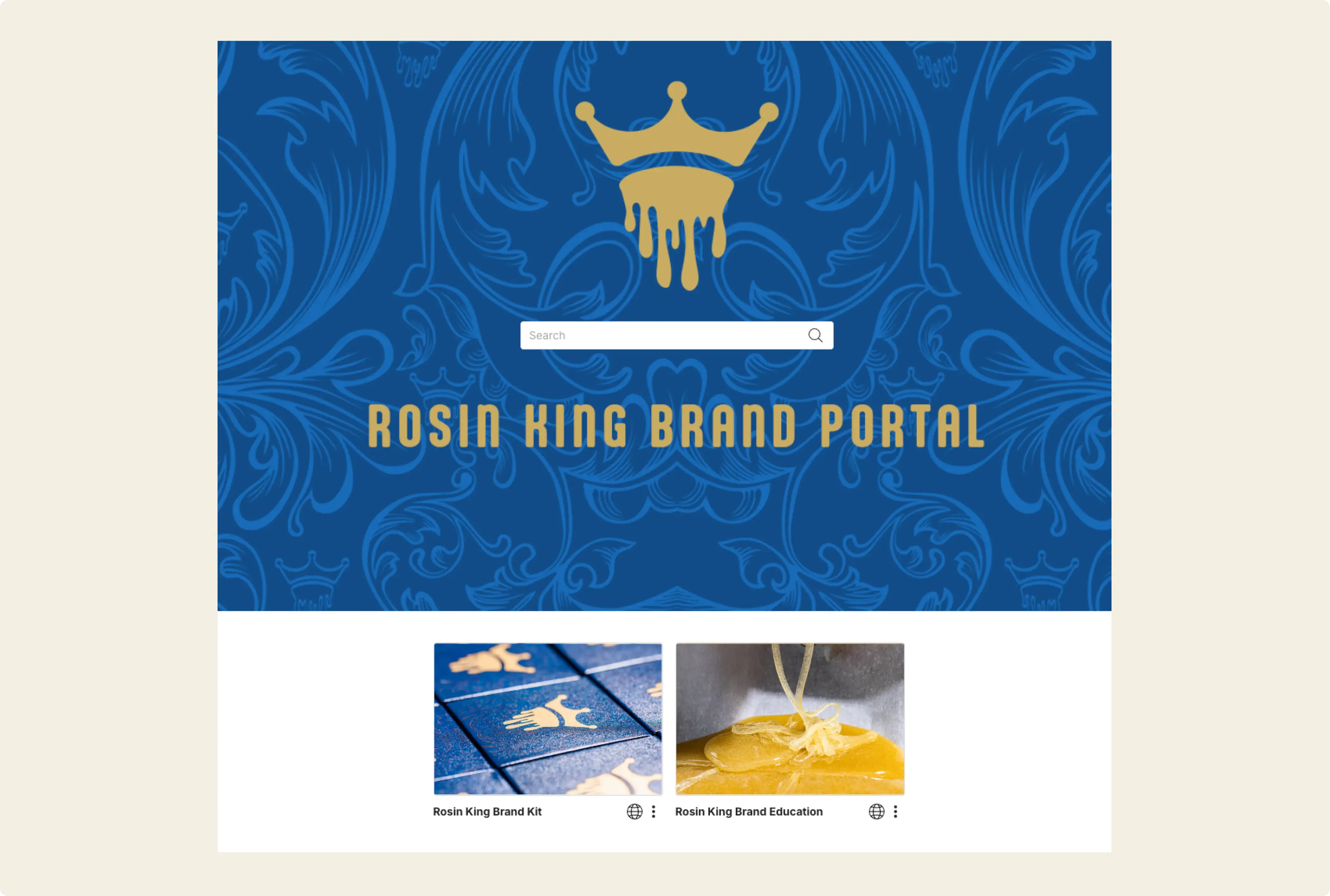
See the Rosin King Brand Portal.
"We want to make the kits pretty," Burrell explains. "But more than that, we need organization. If I’m at an event or a meeting, I need to know that our internal team can go into our Lingo space, find the right tags, and get a retailer what they need without me being the bottleneck."
Pro-Tip: Are you an MSO trying to figure out how this would work for you? Portals are widely used to separate, by state, different Kit assets. Here’s a great article that can help you with your set-up: How to Structure Lingo (DAM) for Multi-State Operators.
One of the biggest hurdles for a brand manager isn't internal creativity—they have a ton of that. What happens to the brand once it leaves the facility and hits a retail point of sale (POS) system is somewhat of a dark void.
This void is where the concept of menu remediation has become a full-time job. Every vendor, regardless of size, eventually hits a wall: you spend months perfecting a brand identity only to have it incorrect on a menu. It's a systemic issue where the high-fidelity world of brand management meets the low-fidelity world of the dreaded inventory spreadsheet. When the data between your facility and the dispensary menus doesn’t sync perfectly, your brand is the first thing to get bruised.
Burrell sees this too, describing a recurring industry headache where a premium brand like Glass Meadows gets shortened to "GM" on a digital menu, or a product gets listed under the wrong brand name.
"It is a major pain point," Burrell says. "When a retailer shortens the name or incorrectly nests a sub-brand like Pre-Roll King of Jersey under the Glass Meadows brand, it kills our SEO. If a customer is searching for us on Dutchie or Jane and the names don't match, we basically don't exist in that search result."
This issue extends to the visuals. Retailers are often so overwhelmed by the sheer volume of shipments that they fall prey to a broken system. Retail teams are moving quickly and in high volume so when product descriptions or image assets are not provided, it’s easy to grab a stock photo of a generic green bud for every strain on the menu.
That leads to menu inconsistencies for the brand, and as a consumer, or a flower connoisseur, you know the presentation and image matter. It’s a no-win situation unless product descriptions and assets are provided each and every time.
"I've seen Blue Zushi and Slurricane listed with the exact same photo," Burrell notes. "Those are two completely different experiences. When the digital menu doesn't match the physical reality of the product, you lose consumer trust before they even leave the store."
In the world of Dutchie, Jane, and Leafly (among others), naming conventions are the difference between a sale and a bounce. It’s why brand managers go through so much effort to make it easy to see how they want to be represented on menus.
For example, Burrell goes through great lengths to make the Glass Meadows brand structure clear using Lingo. Images are downloadable, naming conventions are clear, product lines defined, and descriptions are robust. Between the menu listing assets and the strain library, everything needed for a product listing is clear and present.
If a customer saw a specific strain on Instagram but can't find it on the local dispensary menu because it was entered differently than it’s advertised, the marketing spend is wasted. Burrell is constantly fighting for menu remediation, ensuring that every SKU across every portal reflects the brand’s actual name and categorization, and a big part of why she and the Glass Meadows team use Lingo.
Burrell is providing a truly ‘menu ready’ experience with Lingo. Both retailers and internal teams have one central place for anything they need related to the product. Need to download an image? You can do that in Lingo, with the exact filetype you require. Need a product description, naming convention, or strain information? Glass Meadows makes that easy to find in their Lingo space, too.
Providing the "pretty" kit is only half the battle. The other half is ensuring the retailer uses the assets provided to them. This means the correct image for the correct strain. Using a placeholder image, or an old image, signals to the consumer that the brand, and the retailer, doesn't care about the details. Likewise, when the brand goes through great lengths to overcommunicate descriptions, brand names, and do’s and don’ts, it’s because they care about how they show up.
An excellent example of a menu remediation issue, with the wrong brand and image presented on the menu.
In a "no-smell" state like New Jersey, where customers cannot interact with the flower before buying, the digital asset becomes the only bridge to the consumer. Burrell realized the weight of this responsibility during a visit to a local dispensary.
"The name can only go so far," she says. "Recently I had a budtender show me two products. He pulled out his phone and showed me a video of the plant. He sold me immediately just by showing it to me. That was the moment I realized we needed to prioritize video and high-res visuals over long, boring brand decks."
A 20-page PDF brand deck is where information goes to die. Budtenders are on their feet, dealing with lines and fast-paced transactions, and they need access to something that is in their pocket and quick to show. Burrell’s strategy is to provide 30-second video clips that show the flower, the trichomes, and the vibe of the strain. It's education that fits into the rhythm of a retail shift.
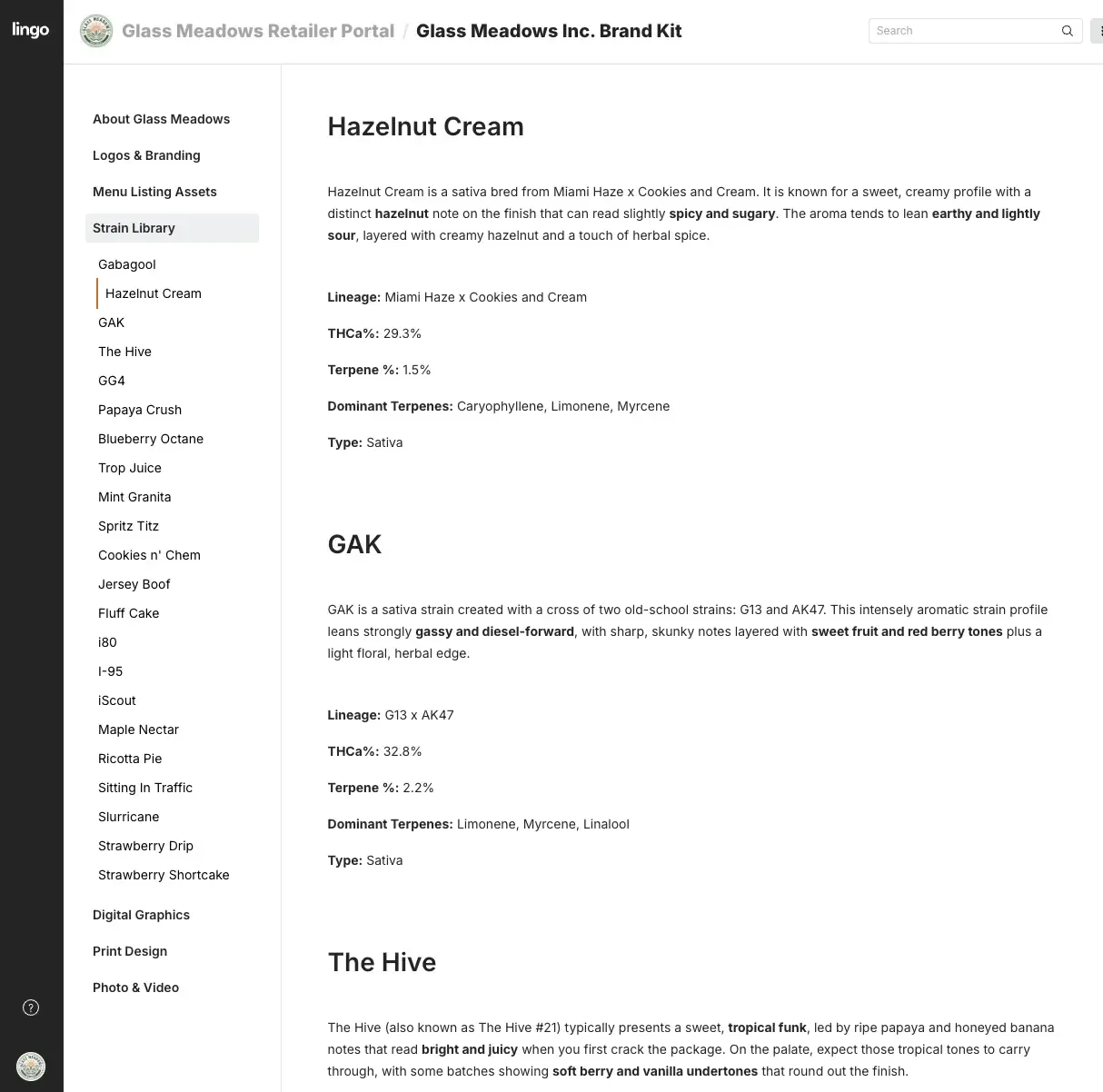
By providing a centralized truth in Lingo, Glass Meadows ensures that retailers have more than just a photo. They have the lineage, the THC levels, and the terpene profiles ready for copy-pasting into menus. This reduces the friction for the retailer and ensures the consumer gets accurate information at the point of sale.
The Glass Meadows Strain Library is available for public viewing.
To survive the day-to-day, Burrell relies on a few tactical hacks that bridge the gap between her team and the busy dispensary manager. These aren't just workflow improvements; they are ways to ensure the brand stays consistent when the manager isn't in the room.
While digital organization is the foundation, the end goal is always menu remediation and consistency of their messaging across all retailers. This sometimes means Moore or Burnell are reaching out to retailers and asking them to update products to exactly how something is worded in their Lingo. And, if you have to do that in volume or scale, that’s a lot of administrative work that they’d love to sideline. Lingo wants to help them do that.
With the needs of cannabis being so unique and challenging, Lingo has launched a Product Information System to help brands communicate to retailers when changes and updates are needed with their products. Not only can their entire catalog be present in Lingo, they can separate out elements of their catalog into each of their Kits. From here, anytime changes are made to a product, or a new product is added in Lingo, an alert is available to any connected entity or retailer, letting them know there is an update to a product.
This is a mock-up of Lingo's Products (PIM) functionality. To join the Lingo Beta, please contact us.
This helps with the back and forth emails, or occasional drop-ins after work, to simply update a product listing. Brands appreciate it because they can see when their changes take effect in the connected retailers, and retailers appreciate it because they are notified of exactly what changes to make for an easy update.
While this is in Beta for the Glass Meadows team, their feedback coupled with that of other cannabis vendors has been paramount in solving the menu remediation efforts once and for all.
“Lingo is already a wonderful tool, but they are taking it up a notch to solve a problem that plagues every brand, point of sale system, and retailer. Giving retailers a reliable source of truth, and making it seamless to communicate changes for menu accuracy is what dreams are made of” states Burrell.
With the creative engine running autonomously behind the scenes, she is free to focus on the next phase of the Glass Meadows expansion. For a Brand Tender, building the team and the systems that allow you to step away from the spreadsheet and back into the brand is what matters most.
We are currently expanding the Lingo PIM Beta. If you are a cannabis vendor looking to automate your menu remediation and streamline retail data distribution, apply to join our Beta cohort here.