Edward Boatman • Nov 12th
The best product content syndication software depends on where your content needs to go. Syndigo with 1WorldSync and Salsify suit brands that need wide retailer networks and rich product content. Akeneo and Inriver suit teams that want syndication tied closely to product information management, or PIM. Productsup and Feedonomics suit feed-heavy workflows. Lingo suits brand and creative teams that need to organize product information, approved assets, and partner-ready content in one visual hub.
There is no single best choice for every team. Start with your required retailers, marketplaces, and data standards. Then check how each tool maps, validates, sends, and monitors content for those destinations.
Research note: Product details and public vendor claims were reviewed on October 7, 2026. Network totals are vendor-reported and may use different definitions.
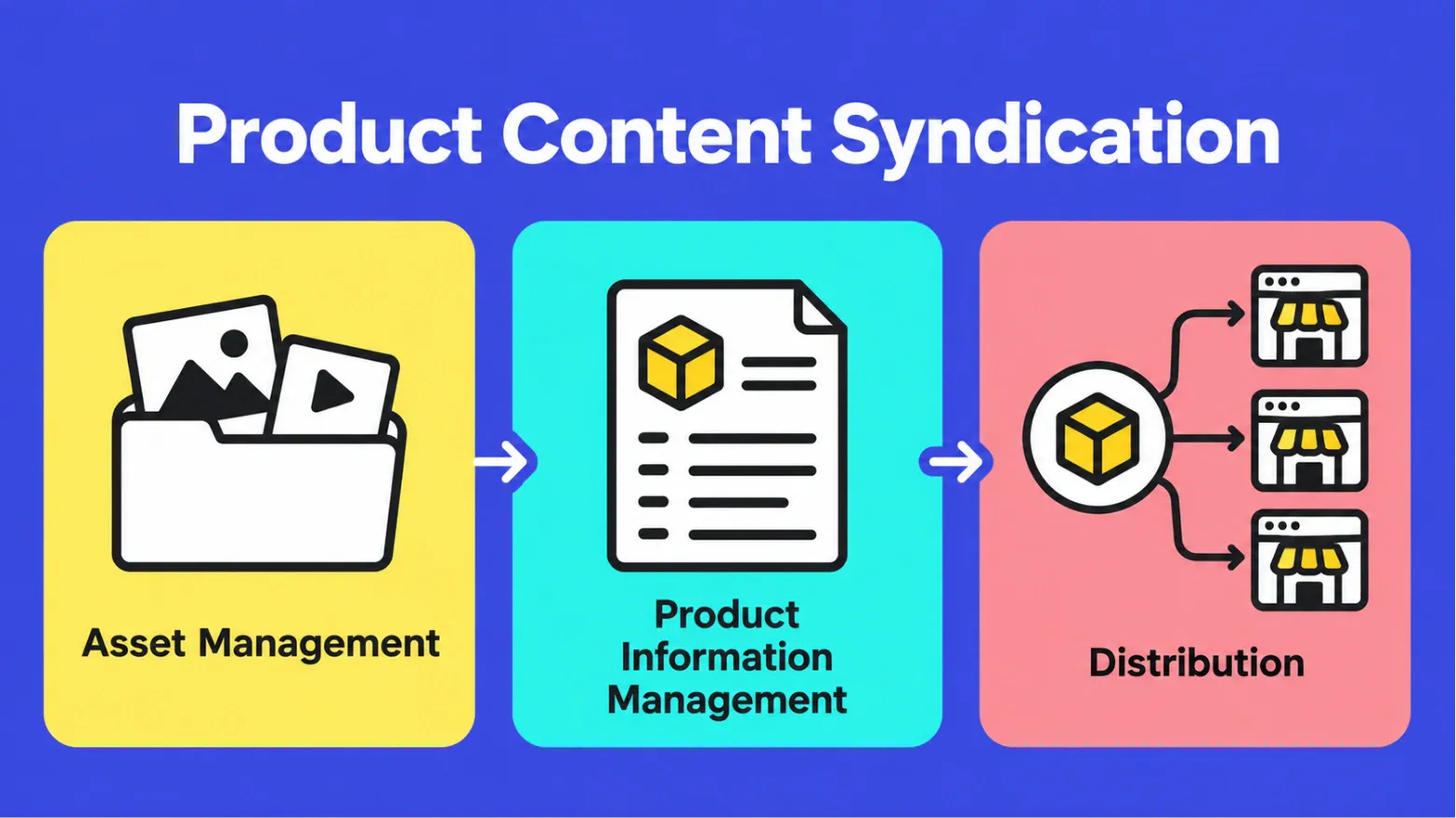
Product content syndication software prepares and sends product information to places where people shop. These destinations can include retailer websites, marketplaces, distributors, ad platforms, and data pools.
The content may include:
Each destination can ask for different fields, formats, image rules, and categories. A syndication platform helps map your source data to those rules. It may also check for missing information, flag errors, send approved content, and report what happened after submission.
That is more than copying the same spreadsheet to many websites. Good syndication software helps a team turn one approved product record into destination-ready versions without rebuilding each listing by hand.
These categories overlap, and some suites include more than one. Still, each has a different main job.
PIM manages the central product record. It helps teams collect, enrich, approve, and govern product data. Syndication takes approved data and prepares it for downstream destinations. A PIM may include syndication, but the two terms do not mean the same thing.
DAM manages creative files such as product photos, videos, logos, packaging art, and brand guidelines. It also stores useful context, such as rights, tags, and usage guidance. A DAM can feed approved assets into a product workflow, but it is not automatically a retailer syndication network. Read Lingo's guide to digital asset management for a deeper explanation.
Feed management shapes and sends product feeds to ad platforms, marketplaces, and commerce channels. It can overlap with syndication, especially for product listings. A feed tool may be a strong fit for Google, Meta, Amazon, or marketplace work, yet offer less support for GDSN or retailer-specific rich content.
GDSN is the Global Data Synchronisation Network. GS1 explains that certified data pools let trading partners share standardized product master data. GDSN matters in industries and retailer relationships that rely on those standards. Not every syndication platform is a certified data pool.
Digital shelf analytics, or DSA, tracks how products appear and perform across online stores. It can find missing content, out-of-stock items, search visibility changes, and other listing problems. NielsenIQ describes DSA as the tools and measures used to track, improve, and predict digital shelf performance. DSA watches what happens after content goes live. Syndication focuses on preparing and delivering it.
The category name on a vendor website is only a starting point. Buyers should check the actual workflow, destination, and connection method.
Product syndication software is most useful when product content must move to many outside destinations with different rules.
You may need it if:
Brand manufacturers, retailers, distributors, and large eCommerce teams are common buyers. Retail, consumer goods, food and beverage, and regulated industries, like cannabis and high-compliance retail, can have a strong need because product rules and channel formats can be complex.
Cannabis brands may also need better product content workflows, especially when they manage many product images, package files, descriptions, and retailer requests across multiple states. Still, a content hub or export is not the same as a live dispensary-menu or POS connection. Ask the vendor to show the exact supported integration.
Some teams do not need a full syndication platform. A university, college athletics department, technology company, or financial brand may use the word “distribution” when its real need is to organize approved assets and share them with people. In that case, a DAM or brand content hub may be a better and simpler fit.
This is not a paid ranking. We included a tool only when its official product information showed a current ability to distribute product data or content to more than one commerce destination.
Each option also had to serve a clear buyer need, such as retailer-network access, PIM-led syndication, feed management, GDSN, or marketplace operations. We looked for enough public information to explain both the fit and an important point to verify.
Syndigo and 1WorldSync appear as one option because Syndigo acquired 1WorldSync in 2025. The companies say current products remain supported while integration continues. Buyers should confirm which product, contract, and experience they would receive.
Use these questions to compare tools fairly:
1. Destination coverage: Does the platform support your exact retailers, marketplaces, distributors, ad networks, or data pools?
2. Connection type: Is each destination reached through a direct API, certified data pool, partner connector, portal, template, or file export?
3. Mapping and validation: Can the system map fields, apply destination rules, and catch errors before submission?
4. Content support: Can it handle the structured data, images, videos, documents, enhanced content, price, and inventory that you use?
5. Source-system fit: How does it connect with your PIM, DAM, ERP, eCommerce platform, and other systems?
6. Workflow and governance: Does it support roles, approvals, localization, version history, and an audit trail?
7. Feedback: Can your team see rejections, correct errors, publish again, and monitor what appears after launch?
8. Services and cost: What will software, modules, network access, integrations, onboarding, managed services, and internal staffing cost?
Vendor network totals are useful clues, but they are not direct comparisons. One vendor may count retailers, distributors, and platforms. Another may count channels, apps, or endpoints. Verify the destinations that matter to you.
The seven tools below solve different versions of the problem. The best fit labels explain where to start, not which platform is best for everyone.
Best fit: Large brands, manufacturers, and retailers that need a broad commerce network, standardized master data, rich product content, or managed content services.
What it covers: Syndigo describes a combined portfolio that includes PIM, master data management, GDSN, product content syndication, enhanced content, digital shelf insights, ratings and reviews, and services. 1WorldSync Content Hub adds item setup, product photography, content services, analytics, and rich-content syndication.
The vendor reports a combined network of more than 3,500 retailers, distributors, and platforms. 1WorldSync also reports rich-content reach to more than 1,000 eCommerce retailers and distributors. These are vendor-reported figures with different definitions, so treat them as scale signals, not proof that every module reaches every endpoint.
Why it made the list: This vendor family covers several hard enterprise needs in one portfolio. It can be relevant when a team needs GDSN, retailer syndication, rich content, content creation services, and post-publish insights.
What to verify: Ask which Syndigo or 1WorldSync product you need, which destinations are part of that product, and whether the connection is direct, GDSN-based, partner-led, or file-based. Confirm how contracts, data, workflows, and support will change as product integration continues.
Best fit: Brands that want product experience management, retailer-specific content preparation, workflow, rich content, and digital shelf monitoring in one environment.
What it covers: Salsify's Connect solution describes a product-content system of record, transformation and validation for retailer needs, rich-media syndication, workflows, and digital shelf analytics. Its product content syndication guide also explains an important limit: not every retailer supports the same direct connection, so templates or other export methods may still be part of the work.
Why it made the list: Salsify connects content preparation with retailer requirements and post-publish monitoring. It also gives buyers useful detail about why retailer coverage must be checked one destination at a time.
What to verify: Bring a list of priority retailers to the demo. Ask which have direct connections, which use templates, and which need custom work. Confirm module packaging, implementation scope, rich-content support, and how the platform handles a rejected submission.
Best fit: Teams already using Akeneo PIM, or teams evaluating a PIM-first product stack with downstream channel activation.
What it covers: Akeneo Activation connects product information with commerce apps, marketplaces, retailers, and custom destinations. The vendor describes channel mapping, transformation, validation, monitoring, and direct publishing. Akeneo reports more than 500 retailer and channel destinations.
Why it made the list: Akeneo gives buyers a clear PIM-first model. Teams can manage and enrich core product information, then prepare approved records for downstream channels.
What to verify: Ask which destinations are native apps, certified channels, partner connectors, or custom channels. Confirm whether Activation requires other Akeneo products, how assets move through the workflow, and what happens when a destination changes its schema.
Best fit: Product teams that want syndication tied to PIM and need both direct endpoints and structured file delivery.
What it covers: Inriver Syndicate Advance describes field mapping, pre-flight validation, destination templates, APIs, partner connections, and delivery by email, FTP, or SFTP. Supported formats listed by the vendor include JSON, XML, CSV, and XLS. Inriver also connects syndication with digital shelf analytics.
Why it made the list: Inriver supports a useful mix of modern APIs and practical file-based methods. That matters because many real retailer workflows are not fully automatic.
What to verify: Ask which priority endpoints are native, which use a partner, and which depend on a template or existing data provider. Test the error report with one difficult product. Confirm the people and process needed to maintain mappings over time.
Best fit: Brands and manufacturers that need flexible feed transformation across retailers, distributors, data pools, and business-to-business formats.
What it covers: Productsup's product content syndication offering supports retailer and distributor connections, data pools, custom integrations, Excel templates, data enrichment, content portals, and industry classification formats.
Why it made the list: Productsup is useful when a company has many feed shapes, including distributor or industrial requirements that do not fit a simple marketplace template.
What to verify: Ask for exact coverage in your countries, sectors, and priority destinations. Confirm who builds and maintains custom connections. Test how the system handles category mapping, media, local fields, and one destination-specific rejection.
Best fit: eCommerce teams that focus on advertising feeds, marketplace listings, catalog optimization, and managed feed operations.
What it covers: Feedonomics describes feed management for ad channels and marketplaces, catalog enrichment, error resolution, platform sync, and order orchestration. Its service model can also help teams that want outside support with feed work.
Why it made the list: Close searches for product syndication often include feed-management needs. Feedonomics represents that part of the market and may fit teams whose most important destinations are ad networks and marketplaces.
What to verify: Confirm whether your need is feed management, retailer-network syndication, GDSN, or a mix. Ask which product-content types are supported, how rich content is handled, which retailer endpoints are available, and where feed tools end and order tools begin.
Best fit: Brand managers, marketers, designers, and creative teams that need to keep product information, approved assets, guidance, and partner-ready resources organized in one visual workspace.
What it covers: Lingo Products brings product information and product assets together. Teams can organize approved files in the Library, add useful metadata and tags, and place product catalogs in Kits. Kits can then be shared through branded Portals so internal teams and outside partners can find the right content with its context.
Why it made the list: Lingo addresses the people's side of product content distribution. It can help brand and creative teams replace scattered folders, old attachments, and disconnected product files with controlled access to approved content. This may be enough when the main need is organized sharing rather than automated retailer submission. Lingo can also sit beside a syndication network and support the product images, creative files, and brand guidance used in the wider workflow.
What to verify: Decide whether you need controlled access for people or automated delivery to outside systems. Lingo is not being presented as a replacement for every PIM, GDSN data pool, retailer network, or feed platform. A Kit, Portal, shared catalog, or export does not mean a retailer site, POS system, marketplace, or dispensary menu updates automatically. That requires a documented and configured integration.
Learn more about this role in Lingo’s guide to brand asset management, or compare options in its guide to DAM software for marketing teams.
Ask for a written list of your priority destinations. For each one, record whether the method is a direct API, GDSN data pool, partner connector, portal, template, or export. Do not accept a total network number as a substitute.
Retailer fields and rules can change. Ask who maintains the mapping, how quickly changes appear, and how your team is notified. Find out whether the fix is included or billed as custom work.
Bring real product records. Test attributes, variants, images, videos, documents, enhanced content, price, and inventory as needed. A platform that handles text and images may not support every rich-content format.
Name the system that owns each kind of information. A PIM may own core product data. A DAM may own approved creative assets. An ERP may own inventory. The syndication layer should not create unclear ownership.
Ask the vendor to show validation, the error message, the correction, and the second submission. Check whether your team can see what changed and who approved it.
Include software, extra modules, data-pool or network fees, retailer connections, usage, implementation, managed services, and internal staff time. A low starting price can hide an expensive workflow.
With Lingo, yes. In fact, we’ll build your product catalog for you.
Use a real retailer schema and a small set of problem SKUs. Include variants, missing data, unusual media, and one planned change. A good pilot shows how the platform works when the content is messy, not only during a polished demo.
It is software that maps, validates, formats, and sends product information and assets to commerce destinations. Depending on the platform, it may also monitor errors and published listings.
No. PIM manages and governs the central product record. Syndication prepares and moves approved content to outside channels. Some suites include both functions.
Product syndication often focuses on retailer, distributor, marketplace, or data-pool requirements. Feed management often focuses on ad platforms, marketplaces, and commerce feeds. The categories overlap, so compare actual destinations and workflows instead of relying on the label.
You may need both. A DAM manages approved creative assets and their context. A syndication platform maps and sends product content to destination requirements. A smaller team may need only one if its workflow is simple.
Do not assume so. Retailers support different connection methods, and some still require templates or structured files. Verify each priority retailer in writing.
Update it when a product fact, asset, rule, campaign, price, inventory value, or destination requirement changes. There is no universal schedule. Set service levels based on your business and each destination.
Only when a documented, configured integration supports that action. A shared portal, downloadable file, or export does not prove that an outside system updates automatically.
The best product content syndication software is the one that supports your required destinations, fits your source of truth, and uses connection methods your team can maintain.
Start with the job. Syndigo with 1WorldSync and Salsify cover broad product-content and retailer workflows. Akeneo and Inriver connect syndication closely with PIM. Productsup and Feedonomics handle different kinds of feed-heavy distribution. Lingo helps brand and creative teams organize product information, approved assets, and partner-ready content for controlled sharing.
Then test the claims with your own products. A short, documented pilot will tell you more than a long feature list.
If your biggest challenge is keeping product information, images, files, guidance, and partner-ready content organized and easy to share, explore Lingo Products. Lingo gives brand and creative teams a visual place to keep approved content and its context together.