Edward Boatman • Mar 17th
Growing fast is the goal. But most cannabis brands hit a wall they never saw coming; not a regulatory wall, not a supply chain wall. A data wall.It’s called the Expansion Tax. Wasted hours, brand mistakes, and lost sales that pile up when your information management can't keep up with your growth result in a costly tax simply for expanding your business.
Lingo operates in the digital asset management space and is the trusted platform for cannabis brands to share their digital assets with an array of audiences. As such, we’re uniquely positioned to provide a comprehensive analysis of over 100 leading cannabis brands currently using the Lingo platform. This data set represents the full spectrum of the industry, ranging from boutique craft brands to the world's largest multi-state operators, including industry titans like Curaleaf, Trulieve, and Canopy USA.
We tracked specific markers across single-state brands and multi-state operators to determine how their brand portfolio size impacted the expansion tax. We clearly identified an “expansion Tax” that scaling brands pay when they rely on fragmented tools like Google Sheets. By quantifying the tipping points where manual systems break, we are able to provide a roadmap for how brands can use a Product Information Management (PIM) strategy to protect their brand integrity and grow without the typical growing pains.
Here's what the data actually looks like, and what the top operators are doing differently.
The average cannabis brand in our database operates across 11.3 states. Across all cannabis brands using Lingo, we’re presenting brand assets in 38 states. Until a brand is represented in three states, many brands continue using a single Google Drive, Dropbox, or Sharepoint for sharing their digital assets. At three states, that process starts to break.
Why three? Because that's when one set of product files, one shared folder, and one spreadsheet stops being a little messy and starts actively costing you money. Every state has its own packaging rules, lab result requirements, and legal disclaimers. A product that's compliant in Florida may need completely different labeling in Massachusetts. At three states a single SKU multiplies by three, which also means the handling of digital assets triples.
Industry data shows that manual data management increases error rates by 40%. For a brand in 11 states with 6 product lines, that means nearly half of your digital menus could be showing the wrong potency, outdated pricing, or the wrong photo, right at the moment a customer is deciding whether to buy.
The fix the biggest operators use: regional asset libraries. Instead of one giant shared folder that anyone can pull the wrong file from, they organize everything by state. A team member in Illinois only sees Illinois-approved assets. That alone stops a whole category of errors before they reach the shelf.

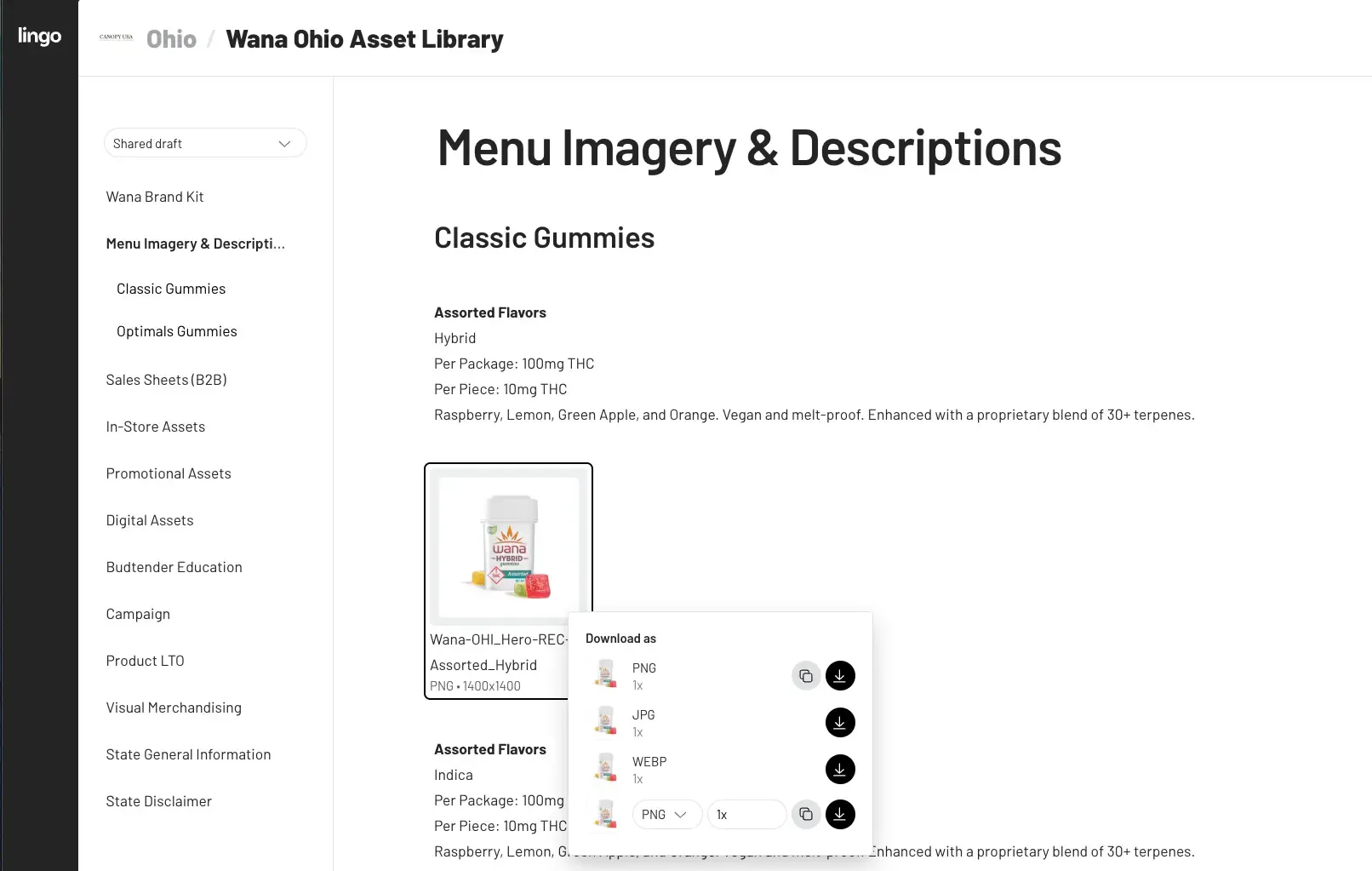
You can view brands in the Curaleaf brand portal in Illinois. Every state they have representation in has a similar, state-specific portal, for their brands.
The companies we studied manage an average of 6 distinct brands per company. Some companies manage 15 brands or more.
Each brand has its own look, its own vibe, and its own wholesale catalog. The risk here isn't just disorganization, it's what we call brand bleed. An example of brand bleed occurs when assets for a premium flower brand accidentally ends up in the same place as the assets for a value brand, and a budtender pulls the wrong one.
Sadly this isn't hypothetical and it happens often when teams share the same Google Drive folder, the same Slack channel, or the same Dropbox login. The solution is different for each type of cannabis company. For example, we’re recommend the following structure:
Three Kits found in a customers ‘House of Brands’ Lingo space.
The result: your premium brands always look luxurious in their Kit, and your value brand passes the vibe check in their own Kit. Your value brand can no longer get confused with your premium brands. And no one has to guess which product images match which brand.
Consumers use digital dispensary menus and kiosks to make their final purchase decision 7 out of 10 times. That makes your product data—the photo, the description, the potency—a direct driver of sales. If you’re missing key product data, you're missing sales.
The problem: most brands are distributing on multiple POS systems at once. Our data shows brands being sold at dispensaries using Jane, Dutchie, Sweed, and Blaze, for example. It means they're managing an ecosystem rather than a single platform, and every platform is pulling from somewhere.

Source: Kerr Consulting
If that somewhere isn't a clean, centralized source of truth, the budtender menu shows a blurry four-year old photo while your marketing team just finished a $50,000 shoot. Lingo serves as the universal translator: one single source of truth that pushes the right assets to every system, regardless of which POS the retailer uses.
The number of vertically integrated operators in the U.S. tripled between 2024 and 2026. Owning the grow, the production, and the retail shelf is a competitive advantage, but only if information flows cleanly from one end to the other.
For vertically-integrated operators, the PIM use case shifts. It's not just about getting the right photo to a third-party retailer. It's about making sure the budtender behind your own counter actually knows your products.
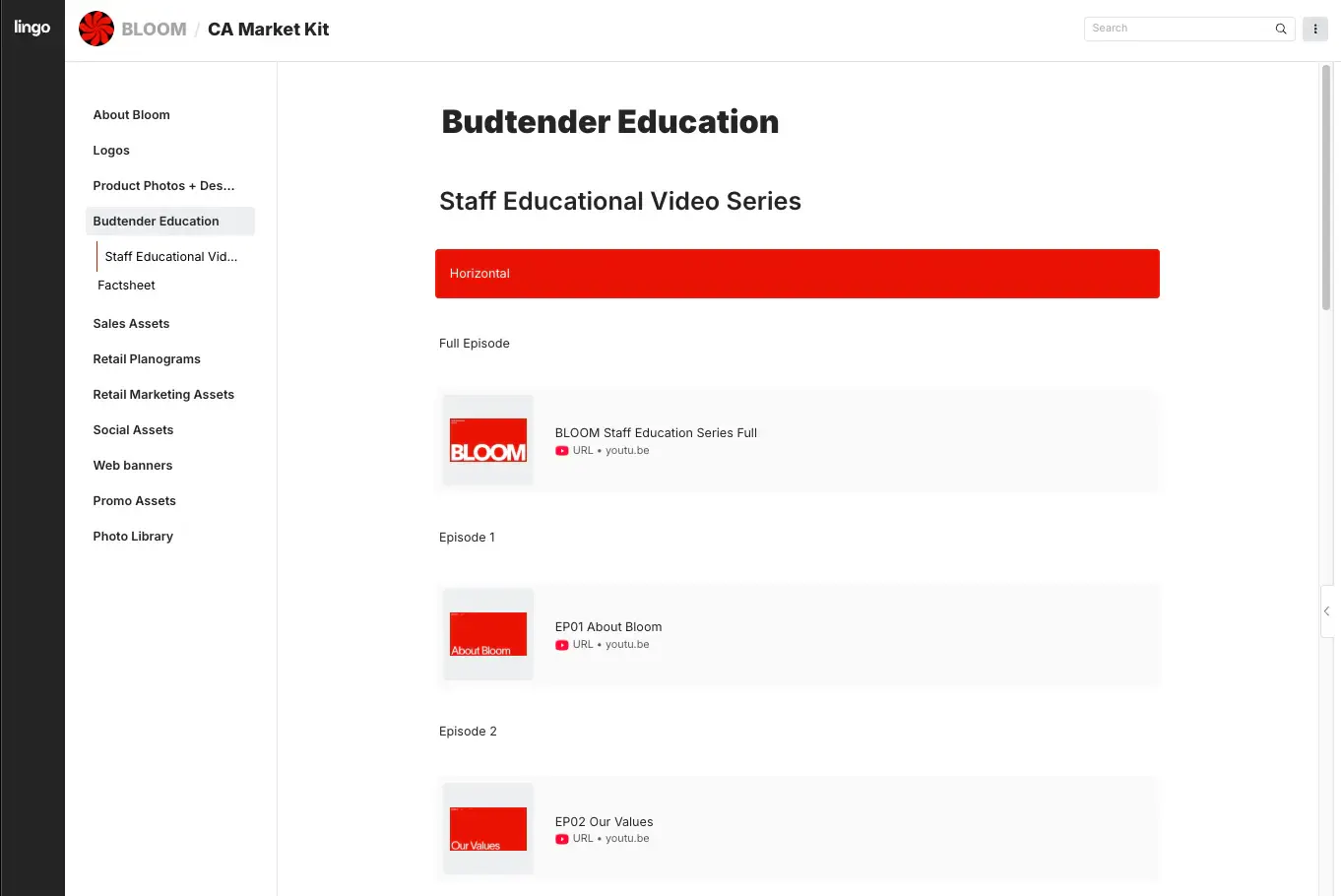
Operators like Bloom solve this by storing staff training videos directly alongside their product assets. One system, one login—new hires learn the nuances of the grow, the product line, and the compliance requirements in the same place where the official assets live. The "source of truth" reaches the consumer through the people representing it.
The California Bloom Market Kit with staff educational videos represented.
When we looked at the most successful cannabis Portals in our data set, we found a significant shift in how they are organized. 82% of top-performing Lingo portals have moved away from a folder by asset type (e.g., all photos in one place) to a folder by product line, or a market ready kits.
This matters because retail buyers and wholesale partners are notoriously time-poor. In the old way of organizing, a retailer would have to search through a "photos" folder, then a "logos" folder, and then a "descriptions" document just to list one SKU.
Lingo cannabis customers have set the new industry standard. It’s a one-click kit, or a single link to a group of digital assets set alongside the context with how to use them. By grouping the downloadable high-res photography next to the product descriptions and lab results, you minimize the risk of pulling the wrong information. These single, SKU-specific listings by state and by brand reduces the time it takes for a retailer to go from ‘Order Received’ to ‘Live on Menu’ by over 60%.
Winning in cannabis today is not just about having the most money. It is about being organized. The best brands have figured out that managing their facts and photos is a secret weapon for growth.
If your team is still using a Google Sheet to track your products, you are likely paying the Expansion Tax. This happens when your business grows faster than your tools can handle. You might notice that your files have messy names like "v3_FINAL_FINAL" and you’re sharing a Google Drive link to a single asset. Or maybe your menus at the store are wrong or promos are late.
When you rely on a spreadsheet, you are asking your team to do a lot of extra work. This is why we created Lingo. Lingo is a digital asset management and product information management (PIM) system. It replaces the messy Google Sheet and becomes your single source of truth.
With Lingo, you stop guessing and start growing. Instead of waiting 24 hours to update a menu, you can do it in seconds. Instead of budtenders guessing how to talk about your product, they have the right videos and facts at their fingertips.
The good news is that these are all problems we can solve together. We’re helping the biggest names in the industry move from spreadsheet chaos to a professional setup.
Are you ready to stop paying the Expansion Tax? Sign up for a demo to see how Lingo can organize your brands today.